
Green Claims

The Green Claims Directive is a European guideline that aims to prevent misleading sustainability claims in marketing and on packaging. Terms such as "natural", "green", "eco", or "sustainable" will only be allowed if they are substantiated and demonstrable.

At Food for Skin, we strive to communicate as honestly and clearly as possible about sustainability, ingredients, and cosmetics. That's why we explain below what certain terms mean, and what they do not mean.

Cruelty-free

Cruelty-free means that a product and its ingredients have not been tested on animals. Important to know: within the European Union, animal testing for cosmetics has been banned since 2013. This applies to both the final product and the ingredients. In other words, every cosmetic product sold in Europe is, in principle, cruelty-free.

Where it gets more complicated is with brands that also sell in markets where animal testing is mandatory for certain products. Outside Europe, different rules sometimes apply. A brand may be cruelty-free in Europe but not elsewhere.

Food for Skin is cruelty-free. Our products and ingredients are not tested on animals, and we do not sell in countries where it is mandatory.

Vegan

Vegan products do not contain ingredients of animal origin. Examples include beeswax, honey, milk proteins, lanolin, carmine (dye from insects), or certain forms of collagen.

Please note: vegan and cruelty-free are not the same. A product can be vegan and still tested on animals (outside the EU), and conversely, a product can be cruelty-free but contain, for example, beeswax.

Our products contain exclusively vegan ingredients.

Vegan does not automatically mean: natural, organic, more sustainable, or better for the skin.

It only says something about the origin of the ingredients.

100% natural

There is no legal definition of natural cosmetics, which means brands are free to interpret the term themselves. Sometimes a product is called natural if it contains just one plant extract, while the rest of the formula is synthetic. We therefore consciously choose 100% natural, so that it is clear what you are applying.

We work as much as possible with natural ingredients that come directly from nature, such as plants, seeds, vegetables and fruits, and are minimally processed. Preferably cold-pressed oils, without heating or chemical solvents. We also use nature-based ingredients, which are mildly processed to make them safe, stable and effective for use on the skin. Our preservation consists of nature-identical ingredients that also occur naturally and are permitted in natural cosmetics.

0% microplastics

Our products do not contain microplastics. These are tiny plastic particles that are used in cosmetics, for example for texture, exfoliation, or a smooth layer on the skin. We prefer to choose ingredients of natural origin and biodegradable alternatives.

Ingredients from waste streams

We try to use as many residual streams as possible to reduce our negative impact on the earth.

This means that parts of vegetables, fruits, or seeds that would otherwise be discarded are reused as raw materials for skin care. High-quality cosmetic oils are pressed from them, which we can then use in our formulas!

Currently, about 20% of our total volume of raw materials is upcycled. We aim to increase this annually.

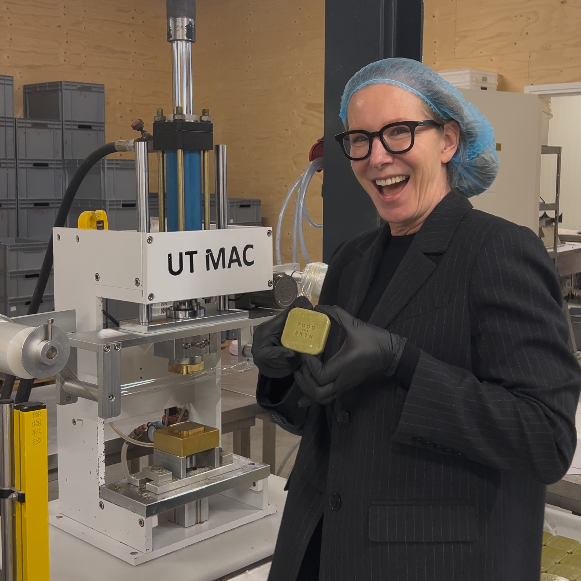
Angela van Food for Skin bij lokale zeepproductie

Sustainable production

Sustainability is complicated. There is almost never one perfect product without impact. We therefore prefer to speak of responsibility instead of sustainability. What we do:

  • Local production in the Netherlands and two products in Italy
  • Recyclable packaging and mono-material: glass with glass, plastic with plastic, cardboard with cardboard
  • (Partially) recycled packaging: 100% PCR tube for sunscreen and shower oil, glass packaging made from 50% recycled glass
  • No cardboard boxes for e-commerce orders
  • About 90-95% of the ingredients come from Europe. All suppliers are European in any case.

Largely organic

If we have the choice for organically certified, we choose that! Currently, most of our products are organic.

Unfortunately, it's not always possible. For many farmers, it's too expensive to be organically certified. If there is no certificate, we do check whether they produce according to organic guidelines. All ingredients are tested in the lab and only cosmetically approved ingredients may be used.

Want to read more about our impact choices?